


Week of October 26-30, 2026
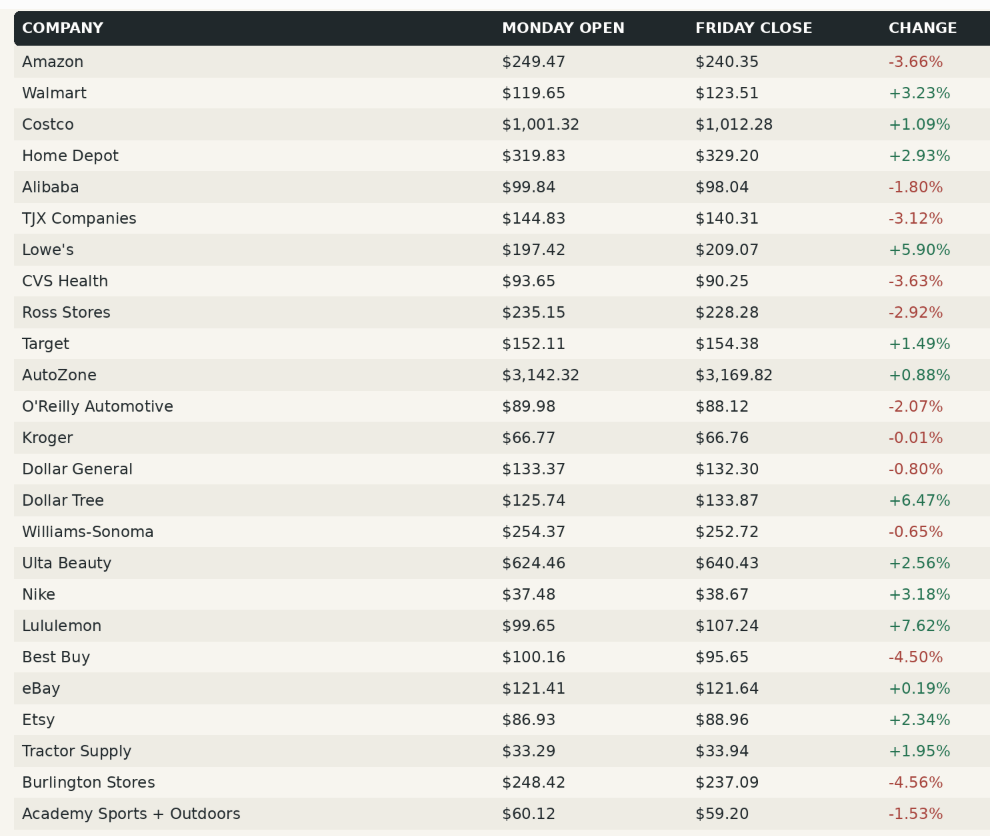
The retail sector delivered a mixed performance during the final week of October, with 13 of the 25 companies in our retail stock watchlist finishing above their Monday opening prices and 12 ending lower. Discount retailers and select specialty brands led the gains, while several major consumer and e-commerce names struggled. The broader takeaway is that investors are entering the holiday season with a divided outlook. Consumer spending remains resilient in certain categories, but concerns about operating costs, technology investment, consumer value-seeking behavior and future profitability continue to influence valuations.
The Week in Retail Stocks
Lululemon was the strongest performer in the group, gaining 7.62% between Monday’s opening price and Friday’s close. Dollar Tree followed with a 6.47% gain, while Lowe’s advanced 5.90%. Nike rose 3.18%, Walmart gained 3.23%, and Ulta Beauty finished the period up 2.56%. These results suggest that investors continue to see opportunities in businesses with differentiated merchandise, strong value propositions or exposure to resilient consumer spending.
The performance of discount retailers was particularly notable. Dollar Tree’s 6.47% increase reinforces the market’s continued interest in value-oriented retail as consumers remain selective about discretionary purchases. Walmart also delivered a positive week, gaining 3.23%, supported by its competitive position in grocery, general merchandise and digital commerce. The performance of these companies highlights the importance of value, convenience and fulfillment capabilities as retailers prepare for the holiday shopping period.
Home improvement stocks also had a solid week. Lowe’s climbed 5.90%, while Home Depot advanced 2.93%. Both companies enter the final stretch of the year facing questions about consumer willingness to spend on larger home projects, but the week’s performance suggests investors see potential for improvement in the category.
On the downside, Burlington was the weakest performer in the watchlist, declining 4.56%. Best Buy fell 4.50%, Amazon dropped 3.66%, and CVS declined 3.63%. TJX Companies and Ross Stores also finished lower, falling 3.12% and 2.92%, respectively. Amazon’s decline was particularly significant given its influence across e-commerce, cloud computing and retail technology. The company’s results and investment outlook reinforced investor concerns about the cost of competing in an increasingly capital-intensive technology environment.
The following figures compare each company’s opening price on Monday, October 26, with its closing price on Friday, October 30. Percentage changes reflect that specific period and are not standard five-day returns measured from the previous Friday’s close.
The Bigger Retail Stories
The week’s retail narrative was shaped by three developments: holiday execution, the growing cost of artificial intelligence investment and the continued importance of value-conscious consumers.
Holiday readiness is becoming an increasingly important competitive differentiator. Retailers are moving into November with a focus on inventory availability, fulfillment speed, store-level execution and the ability to manage demand across channels. Amazon’s seasonal hiring plans and Walmart’s continued expansion of marketplace logistics illustrate how the largest retailers are investing in the infrastructure required to compete for holiday spending. These investments are not simply about processing more orders. They are about improving the customer experience while controlling the cost of fulfillment.
For retailers, the operational implications are significant. Inventory accuracy, reliable store connectivity, mobile device performance and real-time visibility across distribution centers and stores can directly affect the ability to fulfill orders and maintain customer satisfaction. Retailers that cannot accurately locate inventory or efficiently move products through their networks risk losing sales during the most important selling period of the year.
Artificial intelligence also remained a major market focus, although investors are increasingly scrutinizing the financial returns associated with the technology. Reuters reported that major technology companies are dramatically increasing capital expenditures, with projected spending reaching $556.9 billion. The scale of investment is raising questions about cash flow, infrastructure costs and how quickly companies can convert AI spending into sustainable earnings growth. Although this is primarily a technology-sector development, the implications extend directly into retail. Retailers are evaluating AI across merchandising, customer service, demand forecasting, pricing, loss prevention and store operations. The challenge will be separating practical applications that improve productivity from expensive initiatives that deliver limited measurable returns.
Amazon’s quarterly results added another layer to that discussion. The company reported strong growth in its cloud business, with AWS expanding 39%, but its results and investment outlook raised concerns among investors about the financial demands of competing in AI and cloud infrastructure. Amazon remains one of the most influential companies in retail, and its technology investments have implications for the broader industry. Its ability to use automation, data and AI to improve operating efficiency will be closely watched by competitors and investors alike.
Consumer behavior remains another important variable heading into the holiday season. Shoppers continue to prioritize value, promotions and convenience, creating opportunities for retailers with strong pricing positions and efficient operating models. The performance of Walmart and Dollar Tree during the week reflects the market’s interest in businesses positioned to serve consumers who are managing discretionary spending carefully. At the same time, specialty retailers such as Lululemon and Nike demonstrate that consumers are still willing to spend on brands and products they perceive as differentiated. The market is not signaling a uniform pullback in consumer demand. It is signaling that retailers must earn the purchase through value, product relevance and experience.
What to Watch: November 2-6
The first full week of November brings several economic releases and corporate earnings reports that could influence expectations for consumer spending and the broader retail sector. Monday begins with the ISM Manufacturing Index, providing another look at industrial activity and business conditions. Tuesday’s JOLTS report will offer additional insight into labor demand and the health of the employment market. Retail investors will also be watching the weekly ICSC and Redbook sales updates for indications of how consumer spending is tracking as the holiday season approaches.
Wednesday will be particularly important, with the ISM Services Index and ADP employment report scheduled for release. Services activity is an important indicator because it captures a substantial portion of the U.S. economy, including many consumer-facing industries. CVS Health is also expected to report earnings before the market opens, making its results and management commentary important for investors assessing healthcare retail, pharmacy operations and consumer demand. McDonald’s is also expected to report during the week, providing another perspective on restaurant traffic, pricing and the health of the value-conscious consumer.
Thursday’s initial jobless claims will provide another indication of labor-market conditions. The week concludes Friday with the October Employment Situation report, one of the most important economic releases on the calendar. Employment growth, wage trends and unemployment will help shape expectations for consumer spending heading into the holiday period. Investors will also be watching consumer sentiment data for signs of how households are approaching the final two months of the year.
The Bottom Line
Retail enters November with a mixed but constructive outlook. The week’s stock performance shows that investors are rewarding select retailers with strong value propositions, differentiated brands and exposure to resilient consumer demand. At the same time, weakness in Amazon, Best Buy and several other major retailers highlights the market’s sensitivity to earnings expectations, capital investment and consumer spending uncertainty.
The next several weeks will test retailers’ ability to translate holiday preparation into profitable execution. Inventory visibility, fulfillment performance, store technology reliability and disciplined operating costs will matter as much as promotional strategy. For retail executives, the opportunity is clear: the companies that combine a compelling customer proposition with efficient operations will be best positioned to capture holiday demand. For investors, the focus now shifts to November earnings, economic indicators and the first meaningful signals of how the holiday season is developing.